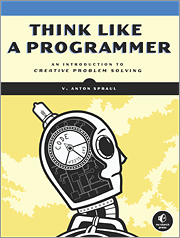
You'll not find there the usual pages with code and algorithms that you'll find in many computer programming books. The code you'll find in C++ and is used mostly for exemplification. Is not a book about code, but one about problem solving. Ideas learned can be applied in many other areas of our life.
The book starts with basic logic problems (classic puzzles), the solution to them and the way of thinking that can lead to a solution. Here we learn about being aware of ALL possible actions you could take, creating strategies and simplifying the problem, looking for the most constrained part of the problem, recognizing patterns and analogies. Just as a side note, I'm member of a chess site, where paying members get to try a huge number of tactical problems and this helps a lot in recognizing patterns in the real game. Programming is similar: recognizing patterns and reducing complex problems to known ones.
Then the book goes through specific type of problems in programming, like problems with arrays, pointers and dynamic memory, classes, recursion.
On very interesting chapter is the one about code reusing. It is teaching when is good and when is bad to reuse code, it helps identifying the components and building a "component toolkit" or component knowledge. It makes use of the knowledge acquired in the previous chapters and interestingly teaches which components to use for a specific problem, based on the amount of work, flexibility and maintainability. It not only presents the way to get to a solution, but also comparing two possible solutions to the same problem and choosing the best one.
In all the chapters I didn't type in and compile the code, since I was not interested in coding but in finding patterns of thinking and ways to improve.
The last chapter puts it all together, teaches how to create a development plan by eliminating weaknesses (both coding and design ones) and using the strengths. Also learning a new programming skill is approached systematically and this is approach interesting also for seasoned programmers.
I'll conclude with a quote from the book: "Once you are thinking like a programmer, be proud of your skills. If someone calls you a coder rather than a programmer, say that a well-trained bird could be taught to peck out code—you don’t just write code, you use code to solve problems."
You can find more details about the book and the table of contents on O'Reilly catalog page.
Tuesday, February 11, 2014
Think Like a Programmer by V. Anton Spraul, O'Reilly Media


Monday, October 24, 2011
Nature and Landscape Photography, by Martin Borg, O'Reilly Media
This post is not at all about a problem in SQLServer or compiling issues but a book review. Why ? Because is all about enjoyment.
In “Nature and Landscape Photography” Martin Borg is presenting a very nice collection of tips for better photography in the outdoors.
Out of many photography books, I was attracted by this one because is written by a Swedish photographer. As nature photography is one of my hobbies, and considering I leave in Stockholm, I was expecting subjects, magical hours and type of landscape to be similar to what I encounter here around Stockholm, and I was not disappointed. This is an easy lecture of 71 short tips from Martin Borg, illustrated with his own pictures. A nice feature is the editor’s insertion of details about each photography. A beginner to intermediate amateur can really benefit from this tips. Many of them are indeed not new, but some are very interesting.
I would’ve probably preferred to have more technical details and more of compositional hints, as well as a little bit of the way the photographer reached to that composition or developed the idea that led to the image. But this is not a manual of photography, is just a collection of tips.
With this book Martin Borg manages to make you wish to go out in the nature and practice the tips (which I did, taking advantage of the nice autumn weather that we had during the first week-end after reading the book). Don’t be scared if you don’t own a Hasselblad camera like the author does, with a decent SLR and a stable tripod you can still reach good results.
For me, the book was useful for a couple of ideas that I probably read before but I was neglecting, some new hints (like breathing on lens, playing with fantasy vs. reality, revealing nature’s strength), as well as for triggering my interest for using neutral density filters.
All in one, the book is a useful and enjoyable reading. I already recommended it to a friend who’s starting with photography.

